

Joel Fichera
Consultant
Joel Fichera
Consultant
On Moats and Competitive Advantages

Photo by Krisztian Kormos from Pexels
Moats are a terminology that has become commonplace vernacular within the world of venture capital and tech investing – however, like most things, it’s a new twist on an old classic. In this case, a moat is a source/dynamic of a competitive advantage which makes it sustainable (as opposed to contestable). A sustainable competitive advantage is one that exists and persists for a long period of time, and the best moats within organisations tend to be those that arise from the strongest resources (in a broad sense of the term).

Photo by Markus Spiske from Pexels
Sustainable Competitive Advantages
tl;dr: Competitive advantages are important, as Porter would tell us, there are only two kinds, those that allow us to charge more and those that allow us to produce at a lower cost. Anything that does not do one of these two things is not a competitive advantage. Common sources of competitive advantage include IP/patents, brand names, customer relationships, and cost management.
Why does it matter:
- Competitive advantages often do not last as long as companies expect or hope, increasing the need to better identify potential sources of more sustainable advantages or protecting and investing in the most sustainable advantages
- Competitive advantages do not persist because companies will copy and adapt to the strategies of their competitors (and their ability to or not is what separates a contestable competitive advantage from a sustainable competitive advantage)
- Putting aside the resources vs positioning argument (see Link 2) – an organisations competitive advantages are the primary source of its ability to outperform its competitors within its chosen market
Link: https://hbr.org/1986/09/sustainable-advantage (this article is from 1986, naturally the dynamics of markets have changed but the principles have not)
Link 2: https://hbr.org/2015/04/strategy-is-about-both-resources-and-positioning
Further Reading: https://www.amazon.com/Competitive-Advantage-Creating-Sustaining-Performance/dp/0684841460
Economic Moats by Brian Laung Aoaeh
Economic Moats for Early Stage Startups
tl;dr: This article is a couple years old now but remains a favourite for me – it’s written by Brian Laung Aoaeh, a then venture capital analyst with a focus on distilling down his experience as it relates to moats for early stage tech companies. He dives into some considerable depth (79 slides), to define startups and moats, key examples of moats: network effects, switching costs, intangibles, cost advantages, efficient scales, and then pulls it all together in the end.
Why does it matter:
- This set of slides could be very quickly turned into a short lecture series, it’s very well structured and reasoned, within each of the moats he builds out the different types within that moat and where possible pulls in some nice graphs and maths to demonstrate the impacts
- Understanding a set of types of moats (and the subtypes within) helps to better understand why and how moats create the sustainable competitive advantages rather than just what are some examples of moats
Link: https://www.slideshare.net/BrianLaungAoaeh/economic-moats-innovation-footprints
Further Reading: https://medium.com/@brianlaungaoaeh/economic-moats-notes-for-early-stage-technology-startups-5-blog-posts-a-presentation-f38d6f636a71
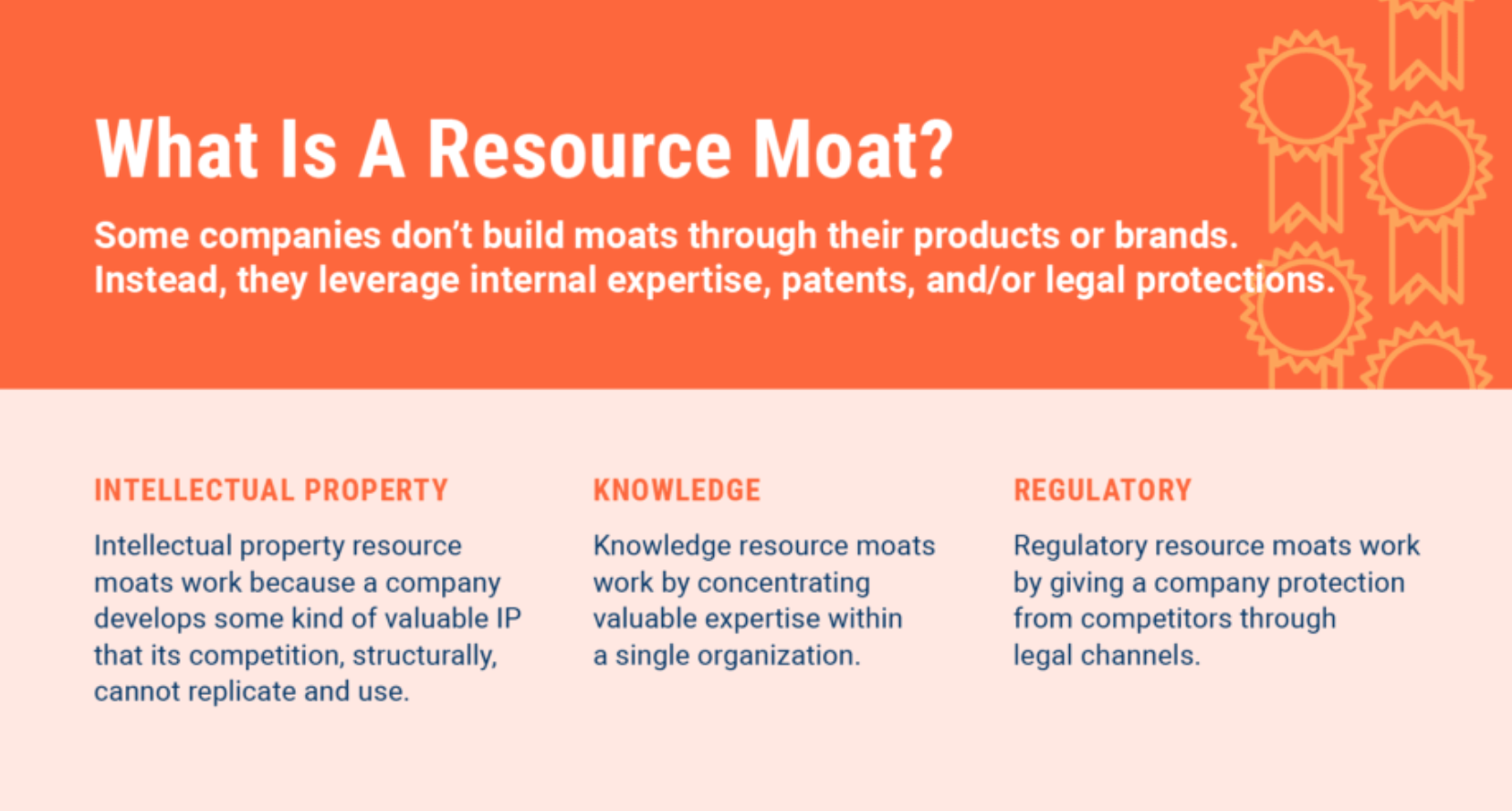
Resource Moats by CB Insights
19 Examples of Moats used by Large Companies
tl;dr: As someone close to me always says “can you give me an example?” Well CB Insights (market research firm, definitely worth signing up for their newsletter) has prepared 19 examples here, spanning four categories of moats: network effects, cost moats, resource moats, and cultural moats (one Brian did not discuss – however, you could argue the impact of brand/traditions is limited in early stage tech companies). The examples include companies such as Disney, IBM, Google, Starbucks, and AT&T.
Why does it matter:
- Seeing how moats have been used by large and established companies helps to illuminate the different kinds of moats and why they’ve been critical in the success of these organisations (note – an established company tends to have had multiple sustainable competitive advantages over the course of its lifetime, and for those that have managed to survive it’s a great source of learning opportunity)
Link: https://www.cbinsights.com/research/report/business-moats-competitive-advantage/
< Read Articles by Me
More Reading Recommendations >
Why Make a Personal Website
Firstly, to see if I could, in spite of mysterious 500 internal server errors. Secondly, to create somewhere I can write publicly, the knowledge others can read my work motivates me to produce better work.

Contact
Email: Joelfichera@gmail.com
Linkedin: linkedin.com/in/joelfichera/
Location: Carlton, Melbourne, Victoria
Contact
Email: Joelfichera@gmail.com
Linkedin: linkedin.com/in/joelfichera/
Location: Carlton, Melbourne, Victoria